Violet glass: special inside and out
Whether in Chinese tradition, in which violet has always been regarded as a universal colour uniting yin and yang, or in ancient Egypt, where precious oils and essences were already kept in violet glass containers: for thousands of years, the colour violet has been associated with the extraordinary and the special, with the sublime, so to speak.
The traditional knowledge that biological substances and liquids stored in dark violet glass keep for longer received renewed attention in the 19th century, when Jakob Lorber (1800-1864, Graz, Austria), among others, increasingly drew attention in his writings to the healing power of sunlight and the special qualities of violet glass.
But how can this effect be explained without mysticism and esotericism?
Sunlight plays an important role here: a large part of its spectrum is already filtered out by the atmosphere, and only a certain part reaches the earth’s surface. The light that arrives on earth can in turn be divided into the visible spectrum, with wavelengths of approx. 390 to 790 nm, and infrared, ultraviolet and radio waves, each of which has shorter wavelengths.
According to the laws of quantum physics, the shorter the wavelength, the higher the frequency of the electromagnetic light wave and therefore the energy inherent in each individual photon. So if a specific photon has a high energy, its reactivity also increases, i.e. it is able to excite a molecule or, in the worst case, destroy it. Foods, for example, oxidise faster because of molecules excited by light.
UV and violet light have a higher frequency, and therefore a larger energy quantum, than light with a lower frequency, such as red and infrared. According to the findings of biophoton researcher Prof. Fritz-Albert Popp, thanks to this large energy quantum, ultraviolet and violet light has on the one hand a bacteria- and virus-killing effect and on the other hand a cell-repairing and cell-regenerating effect.
Preserved & energised.
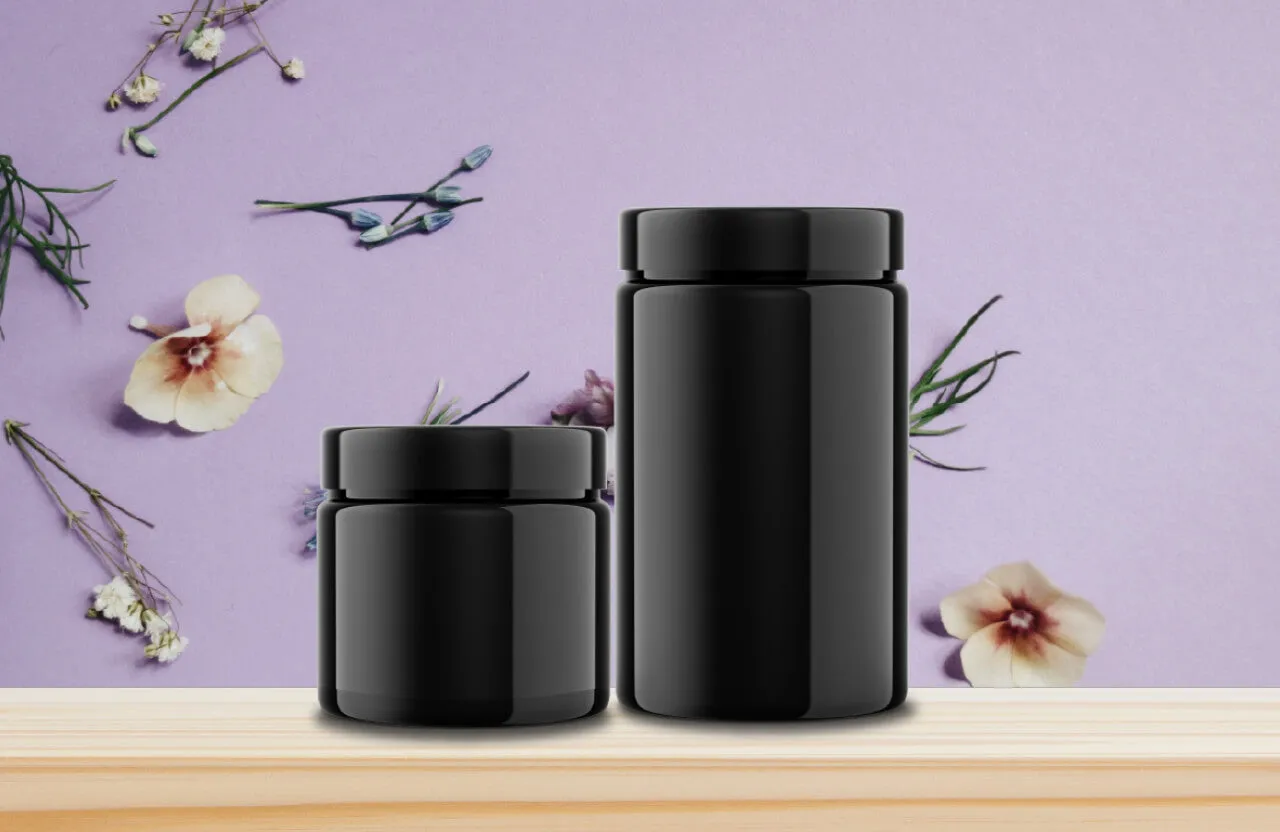
Violet glass makes use of precisely these properties: because of its colour, it only lets through the ‘useful’ visible and invisible ultraviolet, violet and infrared parts of the light and filters out all the other ‘harmful’ parts (blue, green, yellow, red). This creates a unique combination of complete light protection in the photosensitive, visible spectral range (450-750 nm) and a desired medium permeability in the UV range (25%) and in the infrared spectrum (45%).
According to experts such as Prof. Dr. Jakob Jütz or Dr. Hugo Niggli, letting short-wave UV radiation through has the effect that biological substances stored in violet glass are not only better preserved but also stimulated. This creates a unique, additionally energised environment inside the jars that constantly revitalises and strengthens the molecular structures of the substances they contain.
Thanks to these advantages, violet glass is very popular, especially for high-quality and sensitive natural products such as oils, essences and natural cosmetics. As this exceptional quality naturally comes at a price, this form of storage is found mainly in the premium segment of natural products that are particularly worth protecting. This also applies to our high-quality food supplements, for whose ingredients only the very best raw materials are used. And for us it follows logically that the best products deserve nothing less than the best packaging.
In the beginning was the light.
As the largest manufacturer, the company Miron has specialised in producing this very special glass, which is why the Miron brand is now often used as a synonym for violet glass. Its beginnings go back to a glassworks in Slovenia, where Miron had this special form of packaging made by hand purely for its own purposes, namely for storing light-energised solar remedies according to Jakob Lorber. Incidentally, solar remedies are all those natural products that are exposed to the sun for weeks in order to enrich them with light and store the positive powers of the sun (e.g. light globules, poppy flower oil or camphor milk powder). To keep these subtle energies at a constant level for a long time and thus support shelf life, Miron developed violet glass as a unique form of storage.